

The Decameron (1971)
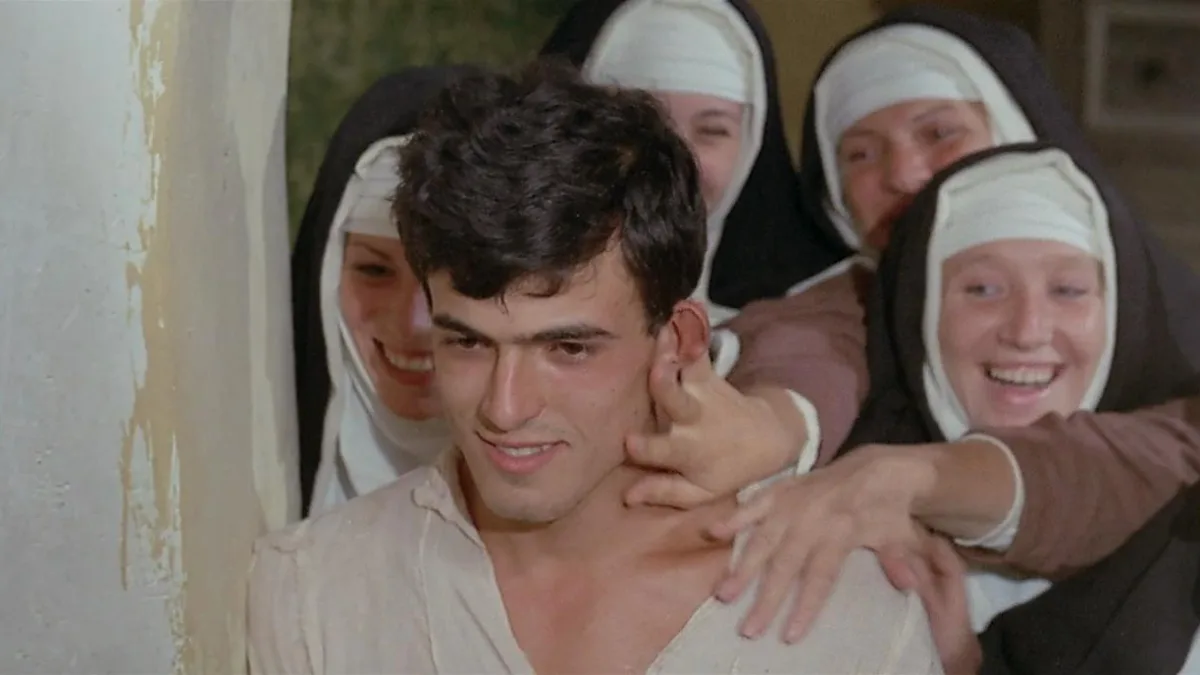
Medieval Naples becomes a filthy, funny carnival of horny nuns, cheating wives, false saints, grave robbers and ordinary folk grabbing pleasure while they can.
Pier Paolo Pasolini’s The Decameron is not a tidy costume drama with polished nobles discussing love over silver goblets. It is a rough, episodic street feast adapted from Boccaccio, full of crooked teeth, bare backsides, sweaty bodies, religious hypocrisy and the cheerful knowledge that respectable society has always been a racket. The film begins with the wide-eyed Andreuccio arriving in Naples to buy horses, flashing his money once too often and falling for a woman who claims to be his long-lost sister. Before the night is over, he has been robbed, dropped into a latrine and recruited by thieves planning to loot a bishop’s tomb. From there Pasolini moves through a string of earthy tales connected less by conventional plot than by appetite, deception and the thin line between sex and death. Masetto pretends to be deaf and...
mute so he can work inside a convent, only to discover that the supposedly chaste sisters have plans for their new gardener. The voluptuous Peronella must conceal her lover when her husband arrives unexpectedly, turning a large storage jar and the husband’s stupidity into weapons of comic survival. Then the mood shifts towards the wonderfully wicked Ciappelletto, a lifelong swindler whose final confession becomes one last audacious con against the Church. Pasolini himself appears midway as a pupil of Giotto, studying faces in the marketplace and painting a religious fresco while the remaining stories unfold around him. A pair of lovers arrange a secret night together on a rooftop; three possessive brothers interfere cruelly in their sister Lisabetta’s romance; a crafty cleric offers to transform a friend’s wife into a horse through a suspiciously intimate ritual; and two companions make a pact to settle the question of whether fornication really earns damnation. Some episodes are broad bedroom farce, one becomes unexpectedly mournful, and others treat death with the same irreverence as sex. The acting is deliberately unpolished, with Pasolini favouring vivid faces and physical presence over theatrical refinement. That rawness is exactly the point: this is life before advertising cleaned it up and sold it back to us. Its people eat, sweat, scheme, pray, copulate and die without pretending the body is anything less than the centre of human existence. The result is bawdy and sometimes downright grubby, yet also strangely innocent—a joyful raspberry blown at money, class and religious authority.
Although rooted in Boccaccio’s 14th-century world, Pasolini shifts much of the action from refined Florence to working-class Naples and fills it with Neapolitan speech, folk music and bustling common life. Filmed around Naples, Casertavecchia, Ravello, the Amalfi Coast, Sorrento and other Italian locations, with additional material shot farther north and in France, it looks like a medieval fresco that has climbed off the church wall for wine, mischief and a quick shag. The vibe is sun-baked, crowded and tactile: dusty lanes, stone courtyards, convent gardens, market stalls and bedrooms where privacy is always one badly timed husband away from disaster.
There is no single female lead, but the women leave a strong impression. Angela Luce plays Peronella with ripe, shameless comic confidence, handling husband and lover as though both were troublesome household furniture. Elisabetta Genovese brings softness and genuine sensual affection to Caterina, while Maria Gabriella Maione makes the woman who ensnares Andreuccio alluring enough for his foolishness to seem understandable. Silvana Mangano appears briefly with grave, aristocratic beauty in a sacred vision, providing a striking contrast to all the cheerful flesh elsewhere. The film contains plentiful female and male nudity, including full-frontal shots, bare breasts, buttocks and vigorously simulated intercourse. It is explicit by mainstream 1971 standards, but never glossy or pornographic; Pasolini presents sex as funny, physical, tender and natural, with the camera just as interested in masculine flesh as feminine curves.

Sign in to comment
The same account you use to watch films.