

Marquis de Sade: Justine (1969)
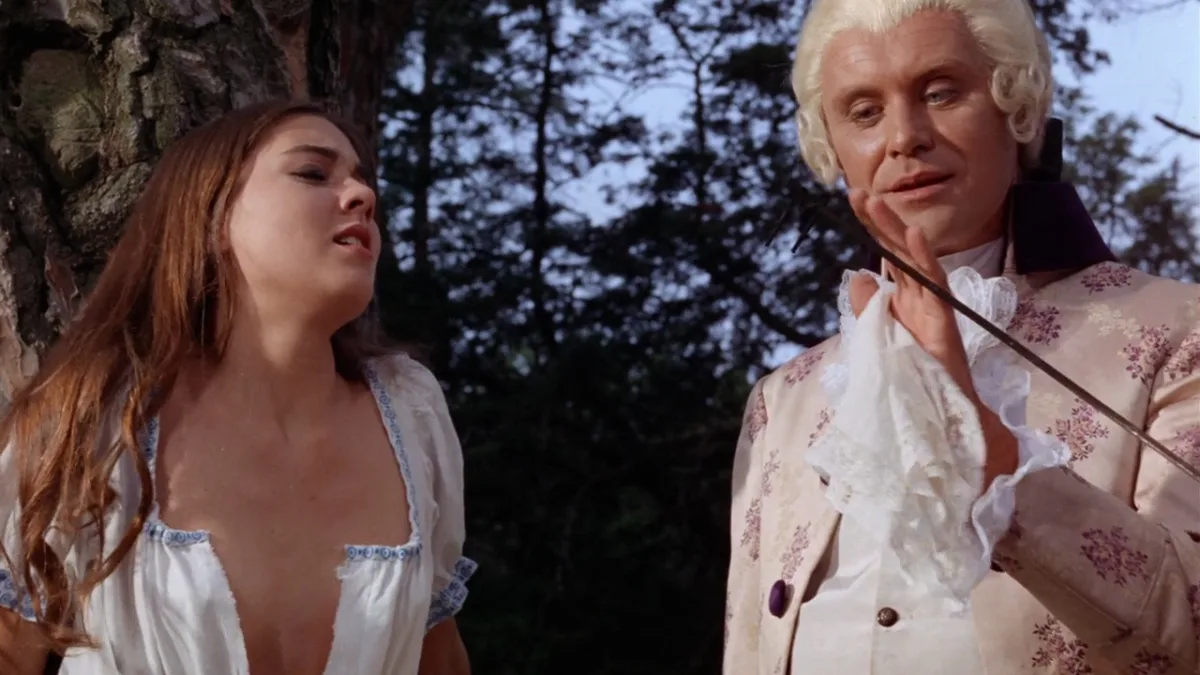
Virtue walks out of a brothel and into two hours of proof that eighteenth-century Europe has far worse rooms waiting.
Framed by Klaus Kinski’s silent, fever-eyed Marquis scribbling in prison while naked phantoms torment his imagination, Jesús Franco’s lavish adaptation follows orphaned sisters Justine and Juliette as they choose opposite ways to survive. Juliette confidently enters a Paris brothel, embraces vice and begins climbing society’s greasy ladder; Justine bolts for the door, determined to preserve her innocence, and is promptly robbed by a monk. That cruel joke becomes the pattern of her life: every time she behaves honestly, another scoundrel spots an opportunity. An innkeeper employs her, orders her to steal from a wealthy guest and then frames her when she refuses. Prison leads to an escape during a fire, but freedom merely lands her among Madame Dubois and her band of criminals, who regard a pretty, frightened girl as communal property. Justine escapes again and finds...
temporary tenderness with Raymond, a painter who seems interested in her as a person rather than a plaything, yet the law soon drives her back onto the road. Shelter at the grand estate of the Marquis de Bressac comes with another indecent bargain: poison his wife or lose his protection. When Justine warns the woman instead, goodness earns its customary reward—betrayal, violence and a brand burned into her flesh. Her journey eventually carries her into a secluded monastery run by four libertine monks, with Jack Palance’s wild-eyed Antonin presiding over their theatrical mixture of lust, cruelty and blasphemy. From there, Justine’s degradation becomes increasingly public, until she is treated less like a woman than an attraction to be displayed. Franco cuts these ordeals against Juliette’s smoother ascent through sex, manipulation and murder, making the sisters two sides of the same bleak argument: virtue suffers while vice gets better clothes. Yet this is not the relentless obscenity the title may suggest. It is an uneven, strangely attractive adult fairy tale—part costume melodrama, part philosophical dirty joke—with sumptuous compositions, lurid coloured lighting and Bruno Nicolai’s romantic score lending elegance to some thoroughly disreputable company. The pacing wanders and several performances chew through the scenery, but the film’s parade of predators has a morbid humour that keeps it from becoming merely grim. It gets under the skin because Justine is not stupid so much as stubbornly decent, clinging to the belief that humanity must eventually prove better than the evidence before her.
The story belongs to a decadent, pre-Revolutionary eighteenth-century France of convent schools, aristocratic estates, prisons, brothels and roadside entertainments, though Franco created it in and around Barcelona. The Palau Nacional, Montjuïc Castle, Park Güell and the old city’s stone plazas give the picture genuine scale, while Gaudí’s curves quietly add to its dreamlike wrongness. The vibe shifts between sunlit storybook adventure and neon-tinted nightmare: handsome, artificial and faintly unhinged.
Romina Power plays Justine with porcelain prettiness, enormous wounded eyes and an angelic softness that makes every approaching rogue look twice as filthy. Her performance is limited but sincere, and her vulnerability gives the sprawling story its emotional thread. Maria Rohm brings Juliette a cooler, knowing sensuality, while Rosemary Dexter, Sylva Koscina and the other women supply the more worldly glamour. Despite Franco’s reputation, the explicitness is relatively restrained: there is nudity, whipping, voyeurism, sexual threat and ritualised debauchery, but little graphic sex. It is more teasingly perverse than genuinely pornographic—a glossy parade of corsets, bare skin, bad intentions and men who should never be trusted with monastery keys.





Sign in to comment
The same account you use to watch films.