

The Girl from Nowhere (2013) – AKA La Fille de Nulle Part
A bruised young drifter enters a lonely widower’s flat, revives his heart and brings a few ghosts along for the ride.
Michel is a retired mathematics teacher, a widower and a professional hermit, living among books, old memories and unfinished thoughts in his large Paris apartment. He spends his days writing a rather grand essay on the beliefs people use to distract themselves from death—religion, love, art, politics, all the usual comforts—until shouting in the stairwell interrupts his intellectual hibernation. Outside his door he finds Dora, a young homeless woman bloodied after an assault, and reluctantly brings her inside. What begins as first aid becomes an open-ended invitation to stay. Dora listens to Michel’s rambling theories, challenges his conclusions and gradually starts editing the manuscript, shifting from wounded guest to sharp-minded collaborator and, eventually, something close to a co-author. Their odd domestic partnership restores an energy he thought had died...
with his wife, though the affection between them remains deliberately hard to label: paternal, romantic, spiritual and perhaps all three at once. Then the apartment begins misbehaving. Voices seep through rooms, objects move, spectral figures appear and a séance raises more questions than it answers. Michel, supposedly the rationalist of the pair, starts wondering whether Dora is connected to his late wife, while Dora approaches the disturbances with considerably more nerve than the old philosopher.
Jean-Claude Brisseau stages all this with almost no money, acting opposite Virginie Legeay inside his own home and turning technical roughness into part of the experience. The stiff line readings and homemade effects can look faintly ridiculous, yet the film’s absolute sincerity gives them an eerie power. One minute it resembles two neighbours arguing over a manuscript; the next, a cigarette shifts by itself or a dark presence materialises and the room suddenly feels unsafe. Beneath the ghost-story trappings lies a tender meditation on bereavement, companionship and the myths we invent because staring directly at oblivion is no way to spend an afternoon. It is slow, talkative and occasionally clumsy, but also disarmingly funny and intimate. By refusing conventional polish, Brisseau creates the cinematic equivalent of an elderly man opening his front door, his private notebooks and finally his wounded heart.
This is early-2010s Paris stripped of fashionable glamour: quiet streets, ageing interiors, shelves packed with books and the sealed-off world of an old intellectual who has largely retired from society. Most of it was filmed in Brisseau’s own apartment, with brief exterior glimpses reminding us that a busy city continues beyond Michel’s curtains. The vibe is part chamber drama, part philosophical fireside chat and part bargain-basement supernatural film—melancholy, eccentric and dreamlike, with bursts of Mahler lending grandeur to its deliberately modest surroundings.
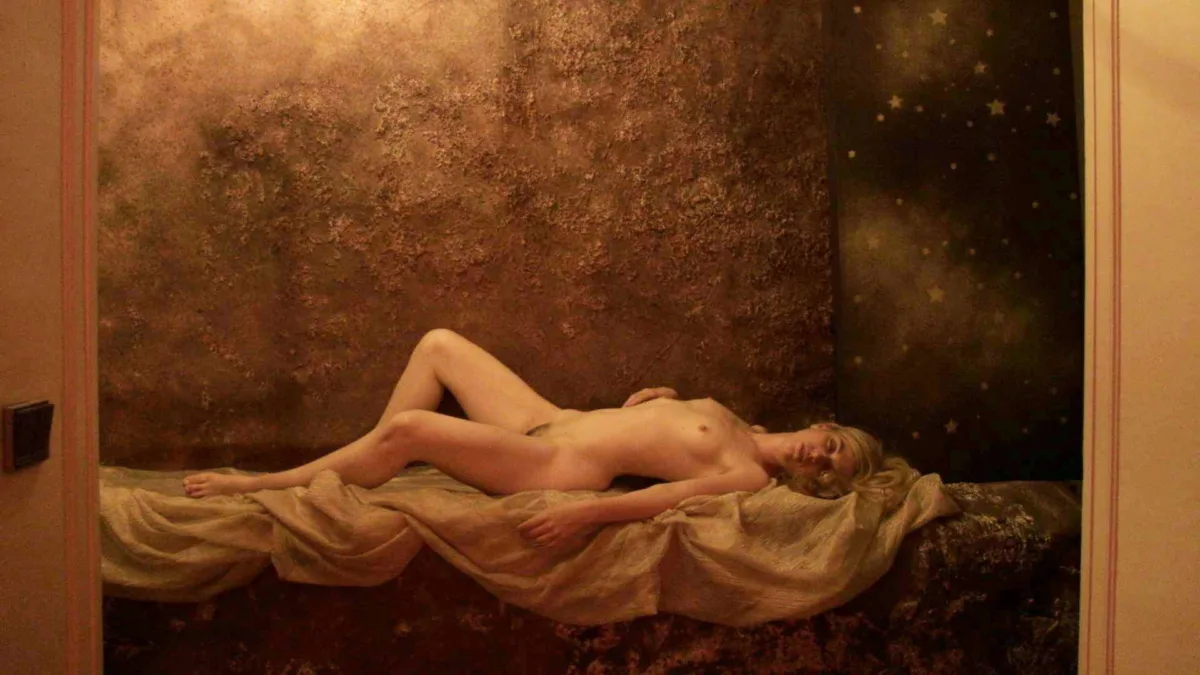
Virginie Legeay makes Dora attractive without turning her into a decorative young muse. Slim, pale and naturally pretty, she has an alert face, an unforced sensuality and the slightly dangerous allure of a woman who may disappear the moment you decide you understand her. Her lively, direct performance plays nicely against Brisseau’s gruff monotone, and when Dora tests the boundaries between guest, companion and desired woman, Legeay handles it with teasing confidence rather than coyness. There is a brief touch of nudity and a little sexual tension, but anyone expecting the erotic heat of Brisseau’s more notorious films will be left with his trousers firmly buttoned. This is not a skin show; Dora’s real seduction is the life she brings into a room that had already begun to resemble a tomb.














Sign in to comment
The same account you use to watch films.