

Art of Love (1983)
Claudine, Yummylicious wife of a Roman army commander falls in love with Cornelius, a young student of Ovid, the Greatest teacher of the Art of Love in 8 AD Rome.
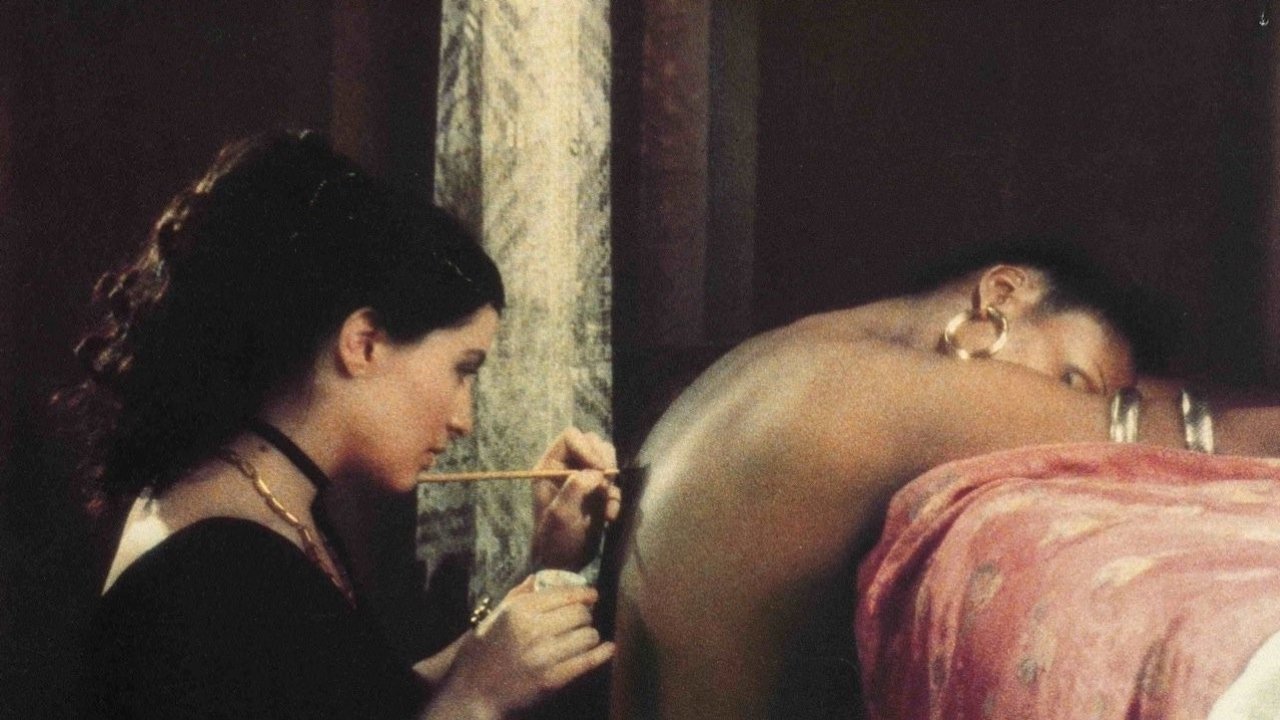
Ovid teaches Rome how to seduce, but Marina Pierro proves that love lessons become dangerous once jealous husbands, loose servants and free-range lust join the class.
In Augustan Rome, the celebrated poet Ovid lectures an eager crowd on his Ars Amatoria, treating seduction as something halfway between philosophy, military strategy and a dirty weekend. His most attentive pupil is Cornelius, a handsome young man who fixes his sights on Claudia, the voluptuous wife of the tribune Macarius. Claudia lives like an expensive prisoner, watched by her suspicious mother-in-law Clio and, rather wonderfully, a caged parrot that functions as feathered surveillance. When Macarius leaves on campaign, Claudia frees the bird and cautiously opens her door to Cornelius. Their affair develops alongside a collection of bawdy side stories involving Claudia’s servant Sepora, the unfaithful Modestina, her brutal general husband Laurentius, a mysterious pregnant widow and various Romans trying to put...
Ovid’s dubious advice into practice. Jealous letters, prayers to Priapus and drunken bedroom games gradually turn the poet’s playful lessons into something far less innocent. Once the soldiers return from Gaul, Claudia must entertain her lover beneath her husband’s nose, while a debauched reception exposes just how thin the line is between pleasure, humiliation and violence in this world. Walerian Borowczyk tells it elliptically, cutting between Ovid’s verses and sensual tableaux rather than building a conventional historical epic. The result is beautiful, odd, occasionally funny and undeniably meandering. Its seductions can resemble an ancient Roman instruction manual filmed through gauze, yet the picture grows darker as male ownership closes around Claudia and the lovers’ private game becomes a genuine risk. Borowczyk is less interested in romance than in desire as a rebellious force—one capable of opening cages, wrecking households and frightening the authorities. The film ultimately reaches beyond its Roman setting toward another age, but exactly how is best left for the final reel.
The period is Rome under Augustus, when public morality, marriage law and patriarchal authority sit uneasily beside a culture obsessed with bodies, gods and erotic mythology. This is no vast, bustling Ben-Hur Rome: Borowczyk works with compact villas, enclosed courtyards, shadowy passages, pale colonnades and rooms whose geography feels deliberately uncertain. The Italian-French production records do not clearly identify the individual filming sites, and the movie relies more on design, costumes and carefully arranged interiors than on famous postcard locations. Soft filters, warm flesh tones, marble light, dark corners, scarlet wine and Luis Bacalov’s music give it the look of an antique fresco having a fever dream. There are visual jokes, ritualistic poses, a wandering parrot and mythological fantasies involving figures such as Priapus, Leda and the Minotaur. The vibe is therefore less swords-and-sandals spectacle than claustrophobic erotic chamber piece: decadent, hazy, theatrical and slightly absurd, with menace slowly seeping into the fun.
Marina Pierro plays Claudia with her trademark proud, full-bodied allure, and Borowczyk photographs her less like an ordinary heroine than a pagan idol who has inconveniently developed feelings of her own. Her heavy-lidded gaze, dark hair and commanding curves carry scenes that sometimes give her too little to say; even standing in a doorway, she looks capable of starting a war. Simonetta Stefanelli brings striking Mediterranean beauty to the enigmatic widow, while Milena Vukotić, Mireille Pame and Laura Betti add comedy, carnality and menace around her. Despite its reputation, this is not wall-to-wall hardcore action: much of the eroticism lies in naked bodies, voyeuristic glances, anticipation and soft-focus coupling. Still, there are flashes of full-frontal nudity, drunken group debauchery, masturbation imagery and explicitly displayed male anatomy, so the film is certainly not shy—just more interested in the ritual and trouble surrounding sex than in mechanically showing every thrust.
Ovid was considered the Greatest teacher of the Art of Love & seduction in 8 AD Rome. This Beautiful Film by Walerian Borowczyk tells the story of Claudine, a Yummylicious Roman Beauty, married to a Roman army commander, who falls in love with Cornelius, a young student seducing her on the instructions of the Great Ovid.
The instructions and methods that Ovid teaches his students, both boys & girls, to get the man or woman of their dreams, seem rather silly in today’s Netflix, Onlyfans & Instagram-porn saturated world, but who knows… They are Heart-warming with the Naive Innocence of ancient times when humans were not OD-ing on stimulation every day.
Nevertheless, Marina Pierro is enough reason to watch this flick.






Sign in to comment
The same account you use to watch films.