

Black Angel (2002) – AKA Senso ’45
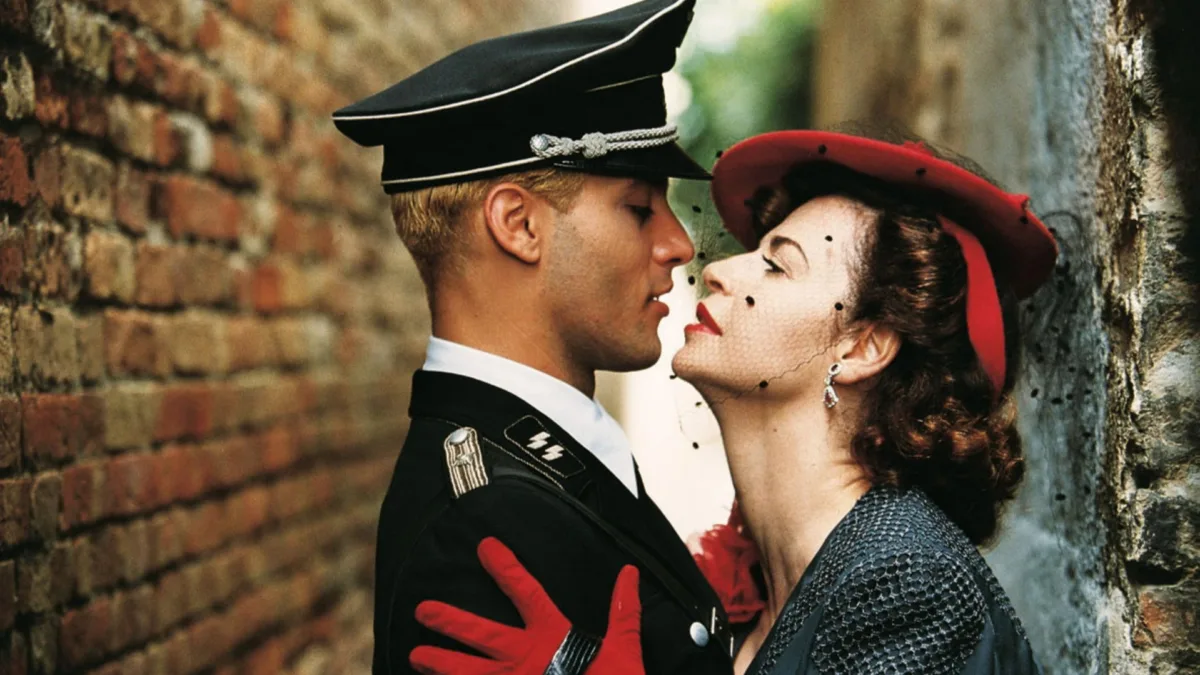
A pampered Fascist wife falls for a Nazi peacock, and soon her marriage, money and common sense are scattered across wartime Venice with her underwear.
Livia Mazzoni is the wealthy, neglected wife of a senior Fascist cultural official, living comfortably while Italy collapses around her in early 1945. On a tense drive from Asolo to Venice, where she hopes to reunite with her German lover, she looks back on the affair that has brought her to this desperate point. Helmut Schultz is a handsome SS officer with the face of a matinée idol, the appetites of a tomcat and all the loyalty of a rented tuxedo. Livia knows he is vain, promiscuous and dangerous, yet his raw attention wakes something in her that polite marriage and social privilege have left half-dead. Their meetings quickly grow from furtive flirtation into a feverish sexual obsession, played out in modest hideaways, grand houses and decadent parties where the ruling class drinks, dances and screws as if tomorrow has already...
been cancelled. As the Fascist regime disintegrates and partisans close in, everyone begins changing loyalties, hiding money and arranging an escape route. Livia, meanwhile, becomes increasingly willing to risk her reputation, security and personal safety to protect Helmut, using her wealth and connections to help him survive the coming defeat.
Tinto Brass treats their affair not as noble forbidden love but as mutually destructive vanity: she wants to feel irresistibly desired, while he wants pleasure, money and a way out. The result is more ambitious and sombre than the director’s lighter erotic romps. Brass still indulges his favourite pleasures—voyeuristic framing, naked bodies, mirrors, stockings and one lengthy orgiastic detour—but here the sex usually serves the story, exposing Livia’s loneliness and Helmut’s cynical control over her. Ennio Morricone’s restrained score lends the picture a melancholy dignity, while the shifts between colour and black-and-white give it the air of a feverish memory colliding with history. Not everything works: Gabriel Garko is physically perfect casting but can seem too glossy to make Helmut fully convincing, and the dialogue occasionally lands with the subtlety of a nightclub proposition. Yet the film develops a nasty emotional pull as Livia’s pleasure turns into dependence, suspicion and humiliation. By the time her husband forces her away from Venice for safety, she is no longer merely having an affair; she is chasing a fantasy through a country coming apart, refusing to admit that Helmut may love his own skin far more than he loves hers. Her return journey brings that fantasy dangerously close to reality, and Brass wisely saves the final reckoning for the last stretch.
The setting is the dying twilight of Mussolini’s Italy, with curfews, German uniforms, resistance activity and nervous Fascists preparing to become respectable democrats overnight. Wartime Venice supplies shadowy alleys, canals and a damp, secretive sensuality, while major interiors—including the monumental Hotel Luna setting—were constructed in Rome. The vibe is decadent, smoky and fatalistic: half political melodrama, half erotic nightmare, with the old order throwing one final debauched party before the bill arrives.
Anna Galiena gives Livia the grand gestures of an old-school screen siren but also finds the frightened, needy woman beneath the fur coats and sexual confidence. She is a mature, voluptuous beauty with heavy-lidded allure, elegant legs and the kind of commanding femininity that makes a room feel warmer the moment she enters it. Brass displays her generously in lingerie, stockings, rear nudity and full-frontal scenes, and the film contains prolonged simulated sex, voyeurism and a large, cheerfully excessive orgy. Galiena never plays the nudity coyly; she makes Livia’s body part of her power, hunger and eventual vulnerability. The supporting beauties provide additional flashes of flesh, but this is unquestionably Galiena’s show—and she gives Brass considerably more than decorative eye candy.














Sign in to comment
The same account you use to watch films.