

Klimt (2006)
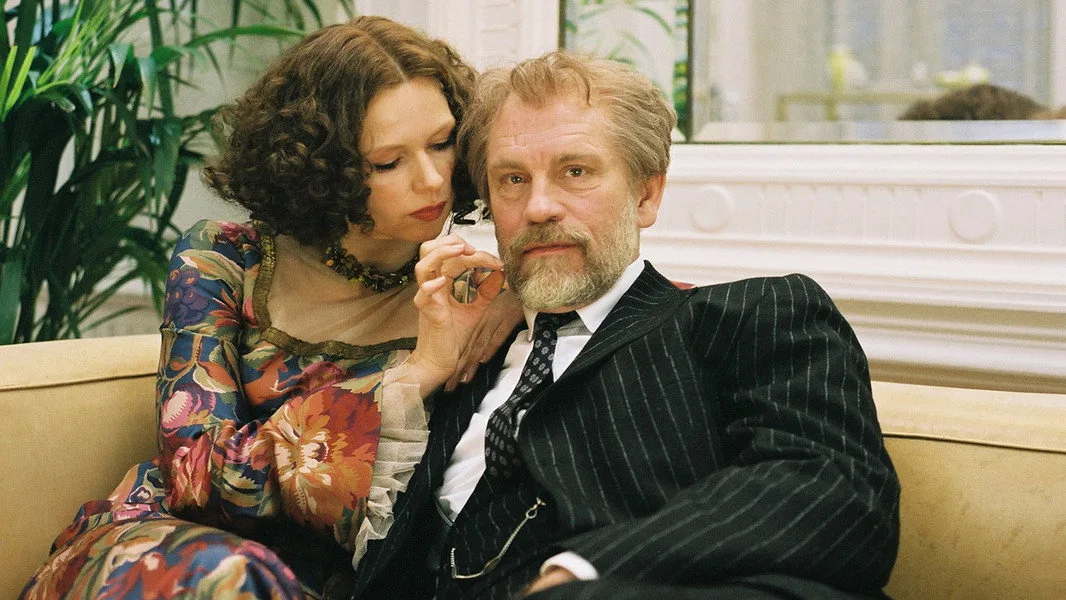
A feverish, erotic dream of Gustav Klimt’s final years, where naked muses, jealous patrons, artistic rebellion and one elusive woman melt into golden hallucination.
Gustav Klimt lies dying of syphilis in a Viennese hospital in 1918, visited by the younger painter Egon Schiele as his mind drifts back through the women, scandals and artistic battles that shaped him. This is no tidy cradle-to-grave biography. Memory moves in circles, faces double, rooms seem to shift and reality regularly slips into fantasy. The central recollection begins at the 1900 Paris Exposition, where Klimt receives a gold medal and meets film pioneer Georges Méliès. A moving image of the beautiful dancer Lea de Castro instantly fascinates him, and he is drawn into the decadent household of her aristocratic lover, Duke Octave. Asked to paint Lea both clothed and nude while the Duke secretly watches, Klimt becomes obsessed—but the woman before him may be Lea, her double or simply the perfect muse his fevered...
imagination needs. Back in Vienna, his independent spirit puts him at odds with officials, critics and the conservative art establishment. His sensual paintings provoke accusations of obscenity, his university commissions become a public scandal, and even the Vienna Secession cannot contain his refusal to obey. Around him gather naked models, mistresses, wealthy patrons, illegitimate children and pompous society figures eager to possess a piece of his talent. Emilie Flöge remains the steady woman in his life, accepting the distance and affairs inside their deep but unconventional bond, while Lea keeps returning like an erotic ghost—always desired, never quite captured. The mysterious State Secretary stalks Klimt’s memories as the voice of bureaucracy and control, Schiele offers youthful admiration, and every success seems haunted by decay. It is intentionally slippery and sometimes confusing, but its confusion has a purpose: we are inside the mind of a sensual, arrogant and fiercely free man trying to make sense of beauty, desire and death before the light goes out.
Raúl Ruiz turns the artist’s life into a moving Klimt canvas rather than a conventional biography. Mirrors, doubles, veils, glowing surfaces and elaborate camera movements make rooms feel seductive and unstable, while Jorge Arriagada’s score adds to the haunted dream. The nudity belongs naturally to Klimt’s world of models and desire instead of feeling pasted on for cheap thrills. The shorter cut can feel choppy, but John Malkovich holds it together with dry wit, intelligence and cool masculine confidence.
Set between 1900 and 1918, the film catches Vienna at the end of the Austro-Hungarian Empire: rich, cultured, sexually restless and already smelling faintly of collapse. Exteriors were filmed in Vienna, including Café Central, while interiors were created in studios near Cologne, Germany. Paris brings theatrical illusion and temptation; Vienna brings cafés, salons, studios, hospitals and suffocating officialdom. The overall vibe is decadent old Europe seen through a dying man’s opium-coloured memory—golden, smoky, cerebral, sensual and slightly diseased.
Saffron Burrows plays Lea as a tall, pale and elegantly dangerous fantasy, giving Klimt just enough warmth to pull him closer before turning cool and unreachable again. Her long, statuesque beauty suits the role of a woman who may be flesh, double or painted ideal, and her scenes with Malkovich carry the film’s strongest erotic tension. Veronica Ferres brings a fuller, warmer femininity to Emilie Flöge, the loyal companion who understands Klimt without pretending she can domesticate him, while Sandra Ceccarelli adds mature aristocratic allure as Serena Lederer. There is frequent female nudity, nude posing, brothel imagery, voyeurism and openly sexual conversation, along with some heated encounters, but this is not graphic or hardcore sex. Its eroticism comes from beautiful women being watched, painted, desired and remembered—the female body treated as Klimt treated it, as both earthly pleasure and serious art.














Sign in to comment
The same account you use to watch films.