

The Future Is Woman (1984) – AKA Il Futuro È Donna
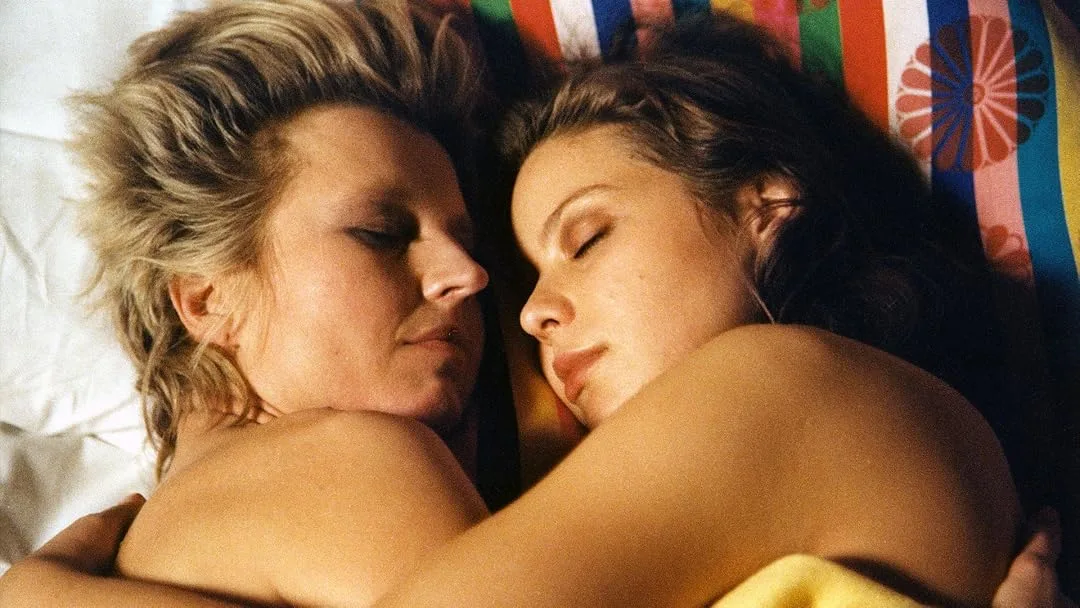
A pregnant Ornella Muti walks into a childless couple’s life, slips into their home and bed, and turns domestic boredom into a very Italian war over sex and motherhood.
Anna and Gordon live like ageing bohemians stranded in the wrong decade. She creates surreal cultural displays for a suburban supermarket, surrounding groceries with waxen tributes to Garbo and Dietrich; he is a former doctor now planting trees among concrete apartment blocks. They have no children, and their restless nightlife suggests two people determined to keep adulthood at arm’s length. During a packed night at a vast disco, Anna rescues Malvina, a beautiful, homeless young woman in the sixth month of pregnancy, from a pack of aggressive men. What should be one night’s shelter becomes an open-ended stay, and Malvina settles into their faded old home with the confidence of a stray cat who has already chosen her new owners. Gordon is fascinated by her body and her freedom, while Anna is drawn to something...
deeper: the unborn child, the promise of motherhood and Malvina herself. Their ménage develops through seduction, jealousy, sudden tenderness and abrupt changes of mood. At times Anna behaves like Malvina’s lover, at others like her mother, protector or rival; Gordon joins the sexual game but gradually realises that the real bond is forming between the two women, leaving him as an awkward third wheel in his own household.
Marco Ferreri refuses to make this a smooth erotic fantasy. Conversations break off, motives shift and scenes sometimes feel like half-remembered dreams, yet the emotional confusion is precisely what keeps the film under your skin. Malvina does not simply seduce the couple—she exposes everything they have avoided admitting about love, fertility, possession and the need to belong somewhere. Ferreri’s claim that the male is becoming obsolete can feel deliberately rigged, with Gordon pushed aside so the women may inherit the future, but this is no cheerful feminist victory lap. The women are hardly liberated saints: they can be possessive, impulsive, cruel and desperately needy. Beneath the sexual politics is a surprisingly bruised longing for family, warmth and continuity in a society that has replaced intimacy with consumption. When the trio attends a rock concert and the crowd erupts into ugly violence, their private experiment is hit by the chaos of the outside world. From there the film sheds much of its urban machinery and moves toward the coast, where Malvina’s approaching birth turns their game of desire into something more primitive and serious. It is uneven, sometimes maddening and never remotely tidy, but its best moments have the strange force of a modern myth assembled from disco lights, supermarket aisles, female flesh and one man’s fear of being left behind.
This is early-1980s Italy seen as a near-future wasteland: neon nightclubs, packed arenas, shopping centres, car parks and concrete suburbs, with old palaces and ancient ruins stubbornly surviving between them. Ferreri assembled his unnamed city from locations across Palermo, Selinunte, Reggio Emilia, Ferrara, Milanofiori and the Adriatic coast. Tonino Delli Colli’s photography and Dante Ferretti’s production design give it a cold, slightly unreal atmosphere—part decadent Euro-drama, part urban nightmare, then suddenly sunlit and elemental when the story reaches the sea. The vibe is sensuous but uneasy, as though the party ended years ago and nobody has found the courage to turn off the music.
Hanna Schygulla plays Anna with mature authority, emotional hunger and a wonderfully extravagant eighties look; she can move from amused seductress to wounded would-be mother without making the contradictions feel false. Ornella Muti, genuinely pregnant during filming, is almost indecently beautiful as Malvina—feline, serene and impossible to pin down, with the kind of face that makes every selfish act look mysterious. Their chemistry easily overwhelms Niels Arestrup’s increasingly displaced Gordon. The film is sexually frank, with nudity, intimate encounters and a strong bisexual charge, but it is arthouse eroticism rather than hardcore spectacle. The real turn-on is the shifting power between the women: Schygulla’s ripe confidence meeting Muti’s youthful, swollen, unapologetically feminine allure.



Sign in to comment
The same account you use to watch films.