

Knife in the Water (1962) – AKA Nóż W Wodzie
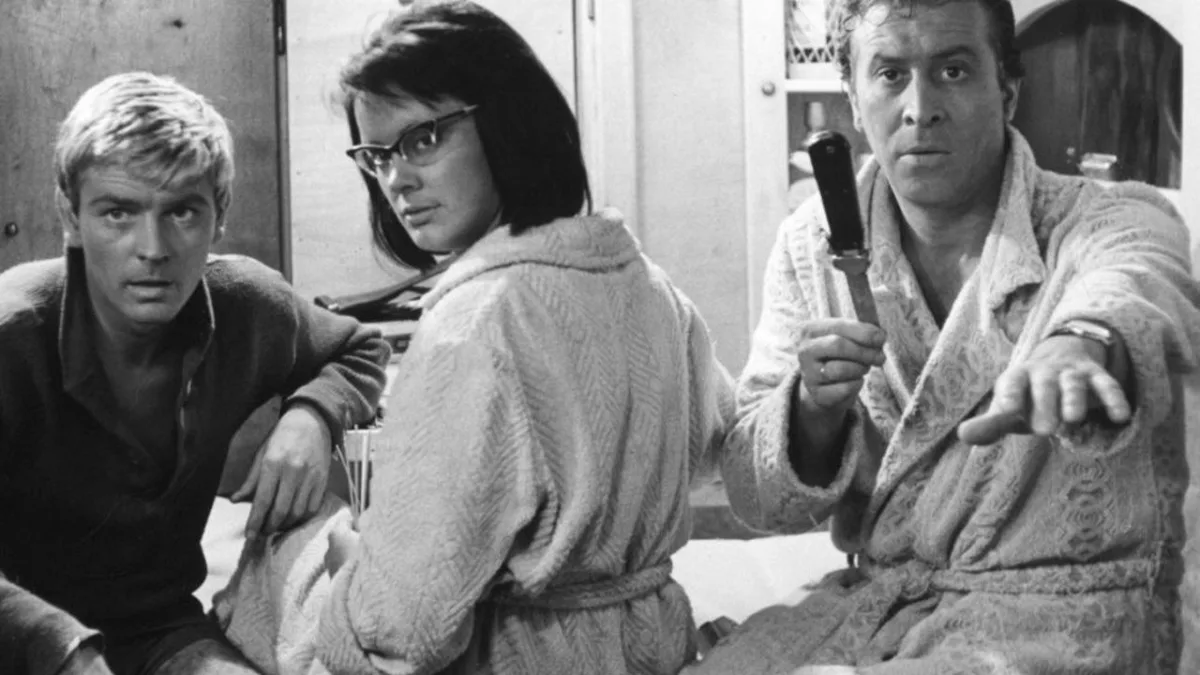
A married couple invite a cocky hitchhiker aboard their yacht, turning a quiet sailing trip into a three-way duel of money, muscle, sex and wounded male pride.
Andrzej, a successful middle-aged sports journalist, is driving to the Masurian lakes with his much younger wife, Krystyna, when a fearless young hitchhiker forces them to stop. Amused by the lad’s nerve—and perhaps eager to show him who has the better life—Andrzej offers him a lift, then impulsively invites him aboard the couple’s yacht. What begins as a generous gesture soon feels more like a private experiment in humiliation. Andrzej has the car, the boat, the wife and the confidence of a man accustomed to giving orders; the unnamed youth has little beyond his athletic body, insolent manner and a switchblade he handles with showy skill. On the cramped boat, every rope, paddle and swimming challenge becomes another chance for the men to measure themselves. Andrzej needles the boy about his inexperience, while the boy...
refuses to behave like a grateful guest. Krystyna watches their childish contest with growing irritation, but she is also clearly aware that the young stranger has brought a dangerous new energy into her stale marriage. Glances linger, bodies brush past one another and small jokes acquire a sexual edge. When bad weather drives the trio below deck, the yacht becomes almost unbearably intimate, and the hostility that has been simmering in the sunshine finally begins to boil. The knife ends up in the lake, accusations fly, and a physical struggle suddenly makes the men’s game frighteningly real.
Roman Polanski directs this simple situation like a slow tightening of a screw. He does not rely on speeches or obvious villains; power keeps changing hands through posture, silence, embarrassment and uncertainty. Jerzy Lipman’s sharp black-and-white photography makes the open lake look strangely claustrophobic, often crowding one face into the foreground while another character watches from behind. Krzysztof Komeda’s cool jazz score adds a sly, restless pulse. The result is not a conventional thriller packed with action, but a tense psychological chamber piece about class resentment, sexual jealousy, ageing and the ridiculous lengths men will go to rather than appear weak. By the time one of them disappears into the water, the couple must face consequences far more complicated than either expected—and the film wisely keeps its final cards close to its chest.
Made at the beginning of the 1960s, the film captures a modernising communist Poland where private cars, leisure sailing and fashionable clothes quietly mark Andrzej and Krystyna as members of a comfortable new elite. It was filmed around Giżycko, Mikołajki and several lakes in Poland’s Masurian Lake District. The empty horizons, shifting clouds, reeds, wind and dark water create a beautiful off-season mood: peaceful at first glance, lonely underneath and increasingly ominous as night closes in.
Jolanta Umecka gives Krystyna a cool, reserved sensuality rather than playing her as an obvious temptress. Tall, dark-haired and striking in her white bikini, she becomes the still centre of the men’s absurd competition, observing both with a mixture of boredom, contempt and quiet curiosity. Her performance can seem deliberately distant, but that suits a wife who has grown tired of her husband’s swagger and is beginning to notice the younger man’s lean physical confidence. The erotic charge comes mainly from looks, proximity and suggestion, with a few discreet glimpses of partial nudity and an intimate encounter handled without graphic detail. This is no skin-filled sex film; its real heat lies in watching attraction become another weapon aboard a boat where nobody has enough room to hide.






Sign in to comment
The same account you use to watch films.